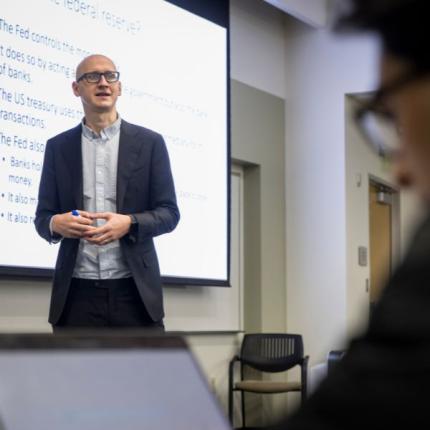
Georgia Tech economist Casey Wichman explains how increased wildfire smoke from climate change affects spending, productivity, and healthcare costs.
Wildfires in the United States are getting bigger and the season is getting longer, fueled by hotter and drier weather from climate change. Even when fires are hundreds of miles away, the wildfire smoke can still harm people's health and create economic costs through air pollution, said Casey Wichman, an associate professor in Georgia Tech’s School of Economics.
The Air Quality Index (AQI) measures how clean or polluted the air is. A healthy AQI is between zero and 50, but when wildfire smoke blows in and settles over cities, the AQI can reach levels of 500 or more. Poor air quality changes where and how people spend their time and money, reduces productivity (even for those working indoors), and increases healthcare costs.
“Environmental regulations like the Clean Air Act dramatically improved our air quality over the past 40 years, but as wildfire season becomes the new normal, wildfire smoke is eroding those gains,” Wichman said. According to recent research, wildfire smoke has erased about a quarter of the progress made over previous decades, and more than half in many western states.
3 Ways Wildfire Smoke Affects the Economy
Air pollution can cost the economy billions of dollars each year, so it’s important to factor it in when calculating the true costs of climate change, explained Wichman, who is an affiliate of Georgia Tech’s Climate, Environment, and Resource (CLEAR) Economics Lab and teaches a course on the economics of climate change.
1.Reduced Spending in the Local Economy
“On days with peak air pollution events, people tend to stay inside more, so they're not going out and spending money that supports the local economy,” Wichman said.
When the AQI is high, people might stay home instead of going shopping, dining out, or spending time outdoors. Businesses that rely on foot traffic receive fewer customers, and outdoor events like festivals, races, or sporting events might be canceled due to air quality concerns.
2. Reduced Productivity
Breathing polluted air has physical effects that make it harder to focus and make decisions. There's evidence that people exposed to air pollution, even for a short time, are less productive, Wichman said. For example, when air pollution is worse, baseball umpires make more mistakes.
“So even if you're working from home to avoid the air pollution or have a desk job, you're still exposed because there’s not a perfect filter between your home and the outdoors, and that reduces the level of productivity you have at work,” he explained.
High AQI levels from wildfire smoke also reduce labor participation in outdoor workplaces such as agriculture and construction, where people may choose to take the day off work to reduce pollution exposure or companies cancel work due to safety concerns.
“Although there’s work being done on the social cost of wildfires, a lot of these impacts on productivity are harder to measure, and they're less likely to be included in the overall cost of wildfires,” Wichman said.
3. Increased Healthcare Costs
Finally, the physical effects of air pollution increase healthcare costs. For example, a study published in Science of the Total Environment estimated that short-term exposure to wildfire smoke costs Americans $11 billion to $20 billion per year, while long-term exposure costs $76 billion to $130 billion per year in health-related damages, including hospital admissions, respiratory and cardiovascular illnesses, and premature deaths (2010 dollars).
“The higher levels of exposure will fall disproportionately on lower-income households who work in more service or consumer-facing industries, who can't shift their work to be virtual or can't afford to take a day off of work even if they would prefer to,” Wichman said.
What Can We Expect With More High Pollution Days?
Wichman says that as high-smoke days become more common, he expects more flexibility with work-from-home arrangements, more disruptions to outdoor labor, and more school cancellations. More frequent shutdowns also mean more lost wages, delayed projects, and reduced economic activity.
“It's kind of similar to snow days,” Wichman said. “It's hazardous on the roads, so school is canceled and people don't want to drive anywhere, so the city shuts down for a couple of days."
Students and faculty in the CLEAR Lab at Georgia Tech's School of Economics use economic tools to address climate change, the energy transition, environmental justice, sustainability, and natural resource management. Their data-driven research evaluates environmental policies and market incentives, helping policymakers make informed, evidence-based decisions.

Casey Wichman is an applied microeconomist working on issues at the intersection of environmental and public economics.