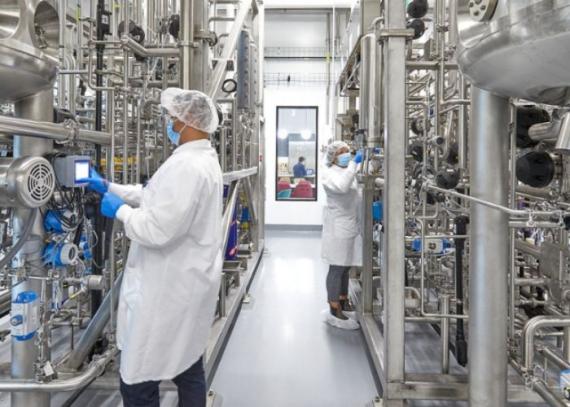
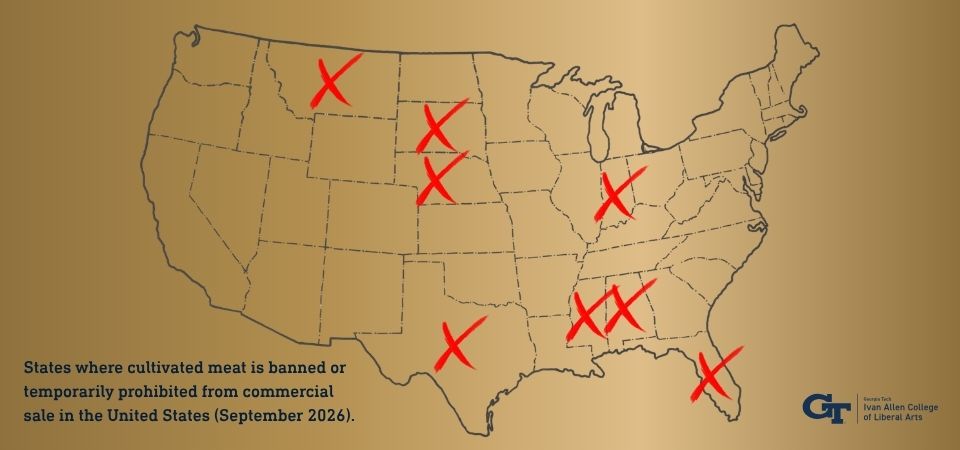
Despite approvals from the U.S. Food and Drug Administration and Department of Agriculture, lab-grown meat — also known as cultivated meat — has been banned or temporarily prohibited from commercial sale in eight U.S. states.
Bill Winders, an expert on the global meat industry at the School of History and Sociology in Georgia Tech’s Ivan Allen College of Liberal Arts, says some farmers support the bans because they feel economic pressure from global competition and industry consolidation. But cultivated meat is still far from mainstream, so the laws address a threat that has yet to materialize.
“The size of the lab-grown meat industry is so small that it's hard for me to envision that consumers shopping at Kroger or Publix or even Whole Foods would be able to encounter or purchase lab-grown meat at any point in the near future,” Winders said. “So, making it illegal to sell it or produce it is almost like making it illegal to sell or produce flying cars. We can do that, but there was not really any threat of flying cars replacing cars on the ground.”
More from Bill Winders: Lab-Grown Meat was FDA Approved. Now What?
Why Are U.S. Farmers Under Economic Pressure?
Winders’ research into the explosive growth of the global meat industry over the last six decades helps explain some of the legislation. He says that, since the 1960s:
Global meat consumption per capita has more than doubled
Total meat production has increased by 500% worldwide
The global meat trade has increased by 1600%, creating more competition for U.S. farmers both in the U.S. and international markets
At the same time, other aspects of the meat industry have been consolidating, such as slaughterhouses and feedlots, giving large companies more economic leverage over the prices they'll pay for cattle or meat
“So, there is this real kind of economic threat that farmers can feel, but it's hard to do anything about the increased meat production and trade that's coming from Latin America or Asia or even India,” Winders said. “But what they can do is to support legislation that prevents the expansion of or support for, especially state support for, lab-grown meat.”
Will Lab-Grown Meat Become Common?
Cultivated meat is currently only sold in a few high-end restaurants, and Winders said it isn’t likely to replace traditional meat anytime soon. This is due in part to political pushback, but mostly to the industry's ongoing challenges with cost and scale.
“When we put it in the context of the global meat industry, lab-grown meat for the near future is certainly not going to replace traditional meat from animals. But it's also not even going to, I suspect, make a significant dent in the market,” he said. “In part because to scale up to have a portion of that market requires such a large capital investment because of the amount of technology that's involved. And then the price, at least currently, just isn't that competitive.”

Bill Winders is a professor in Georgia Tech’s School of History and Sociology, where he specializes in political sociology, social movements, the world economy, and food and agriculture.
He is the co-editor of Global Meat: Social and Environmental Consequences of the Expanding Meat Industry (MIT Press, 2019) and the author of Grains (Polity Press, 2017) and The Politics of Food Supply: US Agricultural Policy in the World Economy (Yale University Press, 2009).