
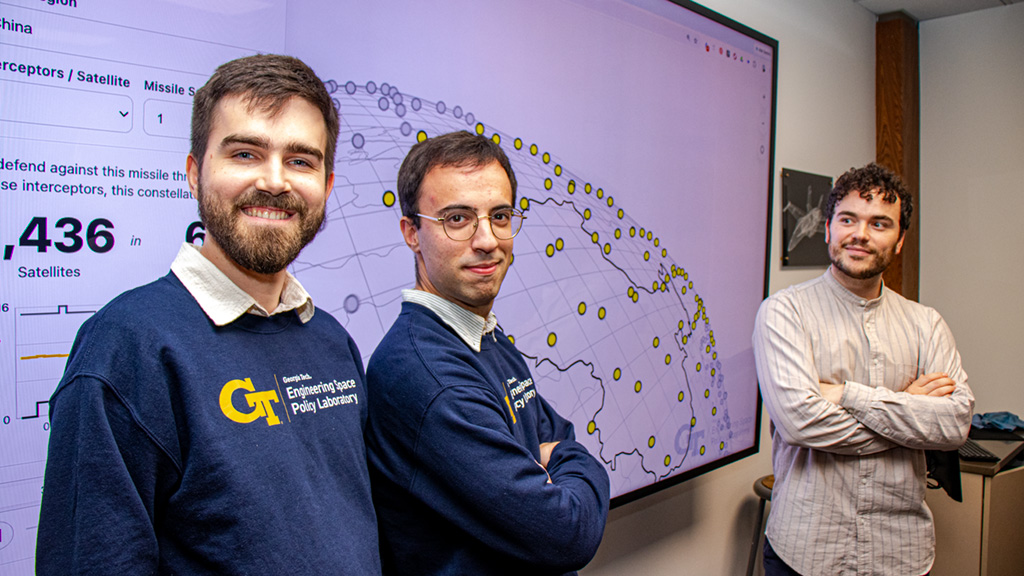
Members of the Engineering Space Policy Lab stand in front of a display showing their "Golden Dome" model. Each dot on the screen represents a space-based interceptor necessary to achieve a specific defensive goal. From left, they are Aerospace Engineering graduate student Nathan O'Brien, international affairs Ph.D. student Fernando Miranda España, and Assistant Professor Thomas González Roberts, ESPL director.
When federal officials announced the “Golden Dome” initiative — a multi-billion-dollar proposal to use space-based interceptors to shield the U.S. from ballistic, hypersonic, and cruise missile threats — it generated sweeping headlines but remarkably few specifics.
Georgia Tech's Engineering Space Policy Laboratory (ESPL) is working to close that understanding gap through a global workshop series funded by $400,000 in grants showcasing an interactive modeling tool developed jointly by engineering and international affairs graduate students.
“There is an enormous amount of ambiguity surrounding these proposals,” said Thomas González Roberts, assistant professor in the Sam Nunn School of International Affairs and the Daniel Guggenheim School of Aerospace Engineering, and director of ESPL.
“How many satellites would be needed? How does that change if each satellite carries more than one interceptor? What kinds of missile threats could a system like this actually defend against? There is a new generation of warfare happening in space, and the American people who are paying for it, as well as U.S. allies, partners, and adversaries, want to know more.”
I unequivocally believe there need to be more conversations between aerospace professionals and policy practitioners”
Housed jointly in the Nunn School and the Guggenheim School, ESPL brings technical rigor and strategic social science together under one roof. The lab functions as a “bilingual” environment where researchers translate complex orbital mechanics into actionable tools for decision-makers.
What Does ESPL’s ‘Golden Dome’ Model Do?
At the center of the lab's current effort are Nathan O'Brien, a second-year master's student in aerospace engineering, and Fernando Miranda España, a Nunn School Ph.D. student.
O’Brien developed the model to calculate how many orbiting interceptors would be needed to cover various contingencies — from small strikes originating in, say, North Korea to a massive attack from Russia or China.
Space-based interceptors can take on different forms, but the modern concept involves satellites equipped with projectiles that can ram into and destroy adversarial missiles in their earliest moments of flight.
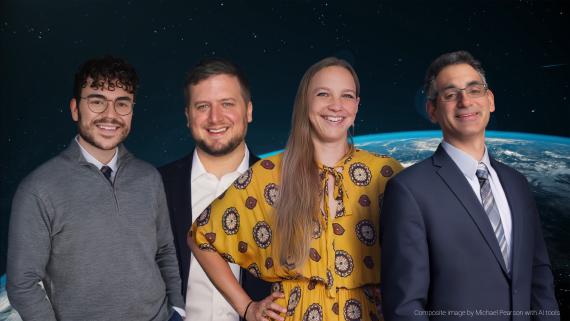
Georgia Tech boasts what is arguably the largest concentration of tenured and tenure-track faculty focused on space policy at any academic institution in the country. From dealing with space debris to avoiding in conflict in space, learn more about their work.
The Engineering Space Policy Lab combines expertise from Georgia Tech's highly ranked program in aerospace engineering with a deep understanding of the international dimensions of space exploration and exploitation provided by the Sam Nunn School of International Affairs.
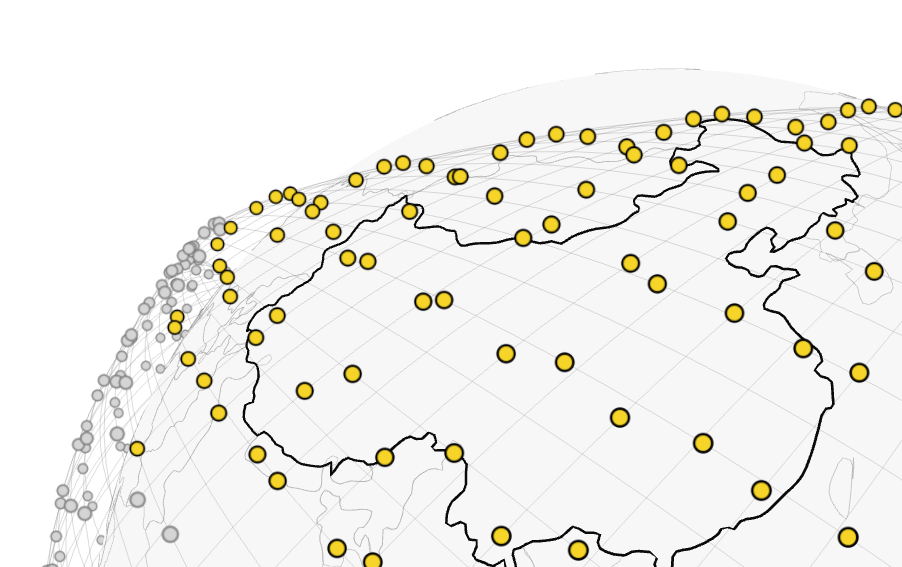
“Our model does not try to show what the proposed U.S. space-based interceptor will look like,” O’Brien said. “Instead, we’re trying to show how a government might position these interceptors on orbit in a near-optimal manner if they want to achieve a certain missile defense capability.”
Miranda España provided the strategic insights for the tool, defining realistic threat parameters such as target geographies and attack sizes based on national security literature.
The model drops the rigid, evenly spaced “Walker-Delta” satellite networks assumed by earlier researchers in favor of custom, asymmetrical satellite structures. O’Brien’s model consequently offers an idea of exactly how many of the costly space-based interceptors would be needed to achieve a given goal. If the U.S. were to choose a more traditional design, even more satellites would be needed, O’Brien said.
As a result, the tool demonstrates fundamental trade-offs that affect any orbital shield:
Dual-Use Ambiguity: Will Golden Dome be purely defensive or, as Roberts says, “a constellation of offensive weapons that could be used to strike targets in space or on the ground? In the eyes of U.S. adversaries, it's all of these things.”
Unintended Escalation: Protecting against one threat places other nations under constant satellite coverage, triggering security dilemmas and diplomatic friction.
Economic Imbalance: Offensive missiles and decoys are far cheaper than interceptors, incentivizing adversaries to build up capacity in ways designed to overwhelm defenses and financially harm the defender.
Nuclear Stability: Because Golden Dome is intended in part to defend against strategic ballistic missiles, it could affect how adversaries assess the credibility of their nuclear deterrents, potentially driving new weapons, countermeasures, and risks to space systems that support nuclear command, control, and early warning.
Understanding Past Responses
Those issues aren’t theoretical, as Miranda España and Roberts point out in their recent paper for the American Institute of Aeronautics and Astronautics examining historical adversary reactions to Israel's Iron Dome and President Ronald Reagan's Strategic Defense Initiative (SDI) in the 1980s.
They found that, unlike ground-based systems that are deployed incrementally, missile-defense initiatives provoke intense responses from adversaries long before a single interceptor reaches orbit.
Examining the reactions to Israel’s Iron Dome, the researchers noted that Hamas and Hezbollah first sent more missiles to overwhelm the system’s defensive capacity. The groups later turned to alternative tactics such as drones.
Looking back to the 1980s and Reagan’s SDI proposal, Miranda España and Roberts wrote that the Soviet Union was initially skeptical of the initiative. But the Soviets eventually realized the strategic implications and began upgrading their missile defense system and exploring countermeasures to the proposed U.S. system, such as space-based mines and other anti-satellite systems.
The researchers argue there’s reason to believe the same thing will happen with Golden Dome — which, unlike Israel’s short-range system or SDI (designed specifically to counter Russia), is meant to protect the U.S. against any missile threat, from anywhere on the planet.
“What we learned from our research is that adversaries will not stay idle in the presence of a defensive system; they will attempt to find ways to bypass it,” Miranda España said. “Adversaries will likely accelerate the development of new delivery systems, increase the number of ICBMs they possess to launch larger salvos, and devise new strategies to avoid coverage.”
Fueling Global Impact
To take their model directly to global policymakers, Roberts secured $400,000 from Longview Philanthropy and Founders Pledge. The awards fund ongoing research and two global workshops co-hosted with the Centre for International Governance Innovation (CIGI) in Canada:
Fall 2026 in Geneva: Puts the modeling tool into the hands of UN diplomats discussing the Prevention of an Arms Race in Outer Space alongside technical and policy experts
Spring 2027 in Washington: Convenes allied leaders, congressional staff, and defense analysts to translate findings into policy recommendations
The collaboration brings together complementary expertise. ESPL provides the technical modeling capabilities, while CIGI contributes expertise in international security and governance and a global network spanning policy, diplomatic, and technical communities. Together, the partners are using the model not simply to illustrate what a space-based missile defense system might look like, but to examine the strategic and policy consequences of different design choices.
“Golden Dome is not just a technical question about whether missile defense can work from space,” said Jessica West, a senior fellow at CIGI. “The choices made about how a system like this is designed and deployed could have profound consequences for nuclear deterrence, strategic stability and security in space. The value of this work is that it allows us to examine those consequences before they become locked into an architecture.”
Translating Equations into Policy Language
O’Brien and Miranda España bring distinct backgrounds to the lab. O’Brien previously managed business development for a student rocket team at the University of Florida and aims to eventually launch an aerospace startup after graduating in May 2027. Miranda España aims to become a university professor training future policymakers.
Bridging disciplines required the students to learn each other's professional language.
“At first, I had to get accustomed to jargon like seed orbits and constellation optimization, while Nathan adapted to my policy lens,” Miranda España said. “Now, the workflow is seamless.”
For O’Brien, working in what he calls the “gray zone” between engineering and policy has proven invaluable.
“I unequivocally believe there need to be more conversations between aerospace professionals and policy practitioners,” he said.
Both view their interdisciplinary training at Georgia Tech as essential preparation for an increasingly complex world.
“In this day and age, I do not think that a high-tech security challenge can be tackled otherwise,” Miranda España said. “Security issues are becoming so complex, with so many moving parts, that collaboration is no longer just an incentive, but a necessity.”