
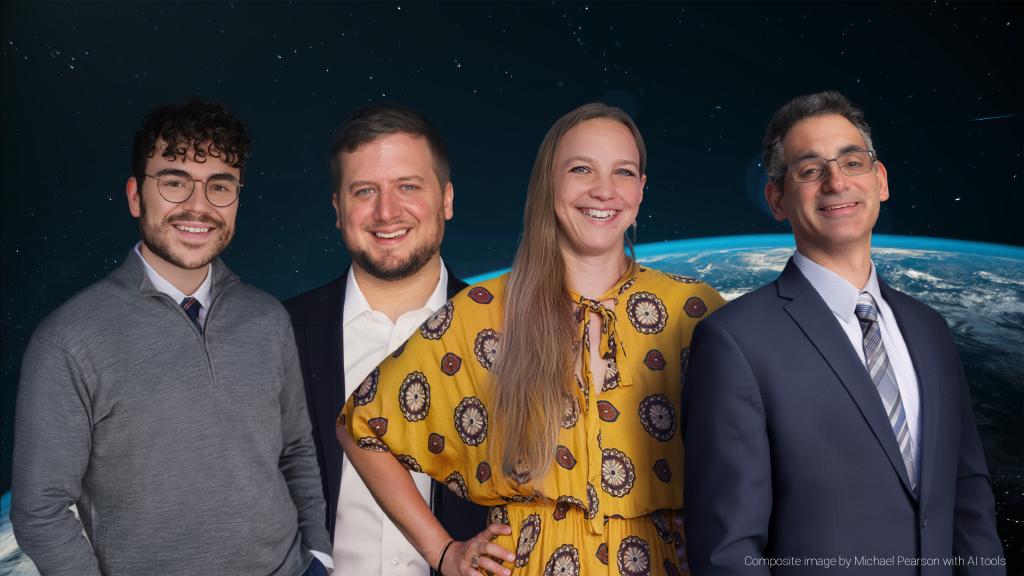
When Associate Professor Mariel Borowitz arrived at Georgia Tech’s Sam Nunn School of International Affairs in 2013, she was the only faculty member at Georgia Tech working full-time on space policy.
Today, she is not only a leading space policy scholar, but also part of what is arguably the largest concentration of tenured and tenure-track faculty focused on space policy at any academic institution in the country.
They are peering into, and preparing for, an increasingly crowded space environment where exploitation could easily boil over into conflict.
“We're at an inflection point for space activity, shifting from steady growth among a relatively small number of actors to rapid expansion in terms of both organizations and spacecraft,” Borowitz said. This is opening up new possibilities for using space technology, but also raises new challenges to avoid accidental — or intentional — damage to space assets. It's essential we confront the realities of what it will mean to compete economically and militarily in this environment."
While Georgia Tech has long been rightfully known for its top-ranked programs in the technology of space, this group is adding noticeable gravitas on the policy side of the house.
I am not aware of another school with this range of expertise embedded in a major technological university doing world class research on space.
Borowitz is working to transform how we track space debris in a temporary assignment with the U.S. Office of Space Commerce. She’s also the editor-in-chief of the journal New Space, and is a noted expert at the intersection of satellite data sharing and international affairs.
Thomas González Roberts, an astrodynamicist with a love for policy and a joint appointment in the Guggenheim School of Aerospace Engineering, leads the Engineering Space Policy Lab (ESPL) — one of the only space-focused labs in the country that gives equal weight to policy and engineering solutions. He recently served as the Academic in Residence at the International Telecommunication Union (ITU) in Geneva, using computational tools to verify satellite operators’ compliance with rules in outer space and monitor “slot squatting” in geostationary orbit.
Colleagues Lincoln Hines and Lawrence Rubin bring their international affairs expertise to bear on analyzing the geopolitical friction of the new space race. Hines specializes in the security and domestic political drivers of China’s space ambitions, while Rubin explores the role that regional politics affects the motivations and trajectories of Middle East space programs.
Together, they form an interdisciplinary hub collaborating at the highest levels to define the new rules of the road for space, from low-Earth orbit to the Moon.
“I am not aware of another school with this range of expertise embedded in a major technological university doing world class research on space,” said Rubin, an associate professor. “We can use that advantage to help shape how the next generation thinks about space, technology, and policy."
The Policy Imperative for a New Space Age
The growth comes amid a transition into what practitioners call the “Third Space Age,” an era in which commercial actors have eclipsed governments in size and influence, and space is no longer just a new frontier ripe for scientific exploration, but one in which economic opportunities and military necessities are driving space activities forward at a breakneck pace.
While technological advancement is hurtling forward, the rules governing what happens in space are lagging dangerously behind. The reality of growing orbital debris, the rise of mega-constellations and the rush to exploit lunar resources all require new international coordination and technical standards, and that is exactly what the Nunn School’s space scholars are rushing to provide.
“The ‘Wild West’ is a myth, but a lack of accountability in orbit is very real,” said Roberts, an assistant professor. “We are reaching a point where the consequences of physical and spectral congestion in space are unignorable: we can either build a verifiable system of world order in the domain now, or we wait for a catastrophe to make it nearly impossible.”
Policy-Infused Engineers, Technology-Infused Policy Experts
To address these pressing issues and help educate the next generation of policy practitioners, the Nunn School launched the Center for Space Policy and International Relations, headed by Borowitz. It serves as a hub for the "critical mass" of scholars bridging the gap between engineering and international affairs expertise.
This footprint is extended into the Institute’s College of Engineering through the ESPL, which Roberts describes as a "bilingual" environment where policy and engineering students work side-by-side to develop evidence-based solutions to challenges in space coordination, sustainability, and security.
“Space is a large and growing ecosystem,” Borowitz said. “All of the major space companies need people who specialize in space policy to understand the national and global landscape.”
As the Third Space Age unfolds, experts at the Nunn School are working to ensure that humanity’s expansion is guided by scientifically grounded policy.
“The goal is to ensure that the people launching the spacecraft and the people writing the rules are speaking the same language,” Roberts said. “At Tech, we have all the tools we need to train the next generation of tech-fluent policymakers.”
Learn more about the issues Nunn School space policy experts are working on:
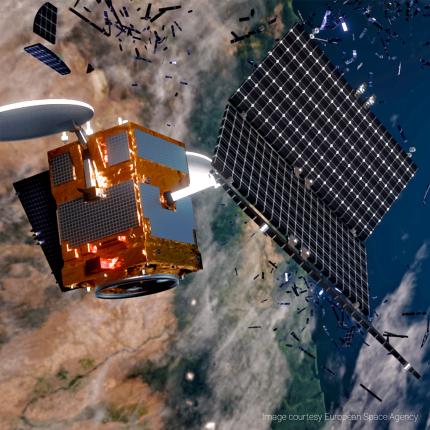
Learn how Nunn School experts are working to help clean up orbital space and prevent catastrophic accidents.

Property rights and logistical issues are becoming more important as space becomes a place of business. Learn more about how our experts are helping create rules for this new marketplace.
Understanding the threat of conflict in space requires an understanding of conflict on the ground, and of the internal logic of spacefaring nations, areas in which the Nunn School excels.