
Nearly 2,000 years ago, Roman philosopher Seneca wrote that the most valuable education was not that which taught calculation or craft, but that which cultivated the moral wisdom to understand whether to do something, and why.
“There is nothing which does not come within the scope of your calculations,” he wrote. “But if you are a real master of your profession, measure me the mind of man.”
As artificial intelligence threatens to out-code coders and out-engineer engineers, Seneca’s call for human discernment over technical capability feels urgently modern — especially amid ever-intensifying debates over the technology’s impact on our economy, polity, and lives.
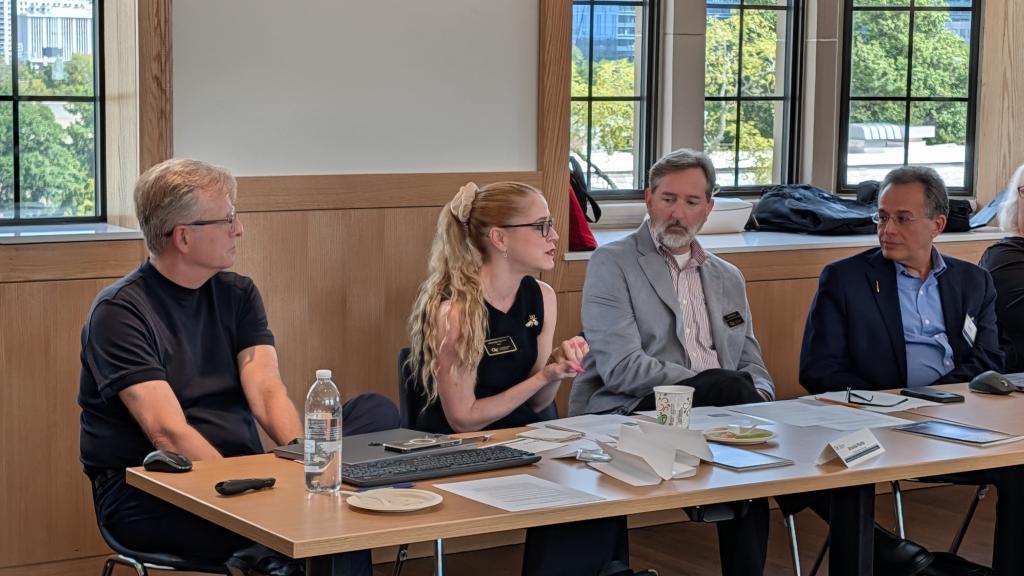
Against this backdrop, liberal arts leaders from technological universities gathered recently in Atlanta at the invitation of Georgia Tech’s Ivan Allen College of Liberal Arts (IAC). Their goal: define the unique role a technologically infused liberal arts education must play in an AI-driven world.
“Some of our colleagues at traditional liberal arts colleges may see AI mostly as a disruptive threat,” said Richard Utz, IAC senior associate dean for strategic initiatives and co-organizer of the Council of Liberal Arts Leaders at Technological Universities (COLLT). “But those of us at technological institutions are used to working shoulder-to-shoulder with engineers and scientists. We turn our fluency with computational thinking toward understanding AI’s opportunities—preparing our students without turning our backs on the enduring lessons of the humanities.”
Protecting ‘Productive Struggle’
A central theme of the COLLT summit was a challenge facing educators everywhere: How to truly educate students in a world where AI makes it easy to generate a polished final product without engaging in the intellectual process required to build it.
“We must protect the productive struggle,” said Ronald Tackett, founding head of the School of Foundational Studies at Kettering University. “For far too long, the final product was our mechanism for assessing engagement in the learning process. AI throws that out the window. We need to ensure students still undergo the friction that builds true capability.”
In the Ivan Allen College, faculty are already putting this principle into practice, designing coursework that uses AI to deepen human engagement rather than bypass it.
For instance, in a recent technical communications class, students used AI not to research or finish assignments, but to roleplay against a “difficult teammate” to help understand the role of communications in complex workplace politics. In another course, they learned just how much employees need to spend time understanding their workplace before asking an AI to help draft workplace documents. In a third, students spent a semester auditing AI systems, leading to “intervention plans” that would help a company address shortcomings in the increasingly ubiquitous technology.
“It’s great to learn to build things or to write code, but you need something to build about,” said Lelia Glass, associate professor of linguistics in the School of Modern Languages. “The ‘why’ question is fundamentally about people — their assumptions, goals, and social context. That is what we study in the liberal arts.”
How the Liberal Arts Help Cultivate Judgment
As AI automates routine tasks, entry-level job roles are shifting dramatically. COLLT leaders argued that higher education must move beyond basic technical training to foster high-level human judgment.
"The world is about to have no shortage of people who can prompt an AI," Tackett noted. "It will have a desperate shortage of people who know enough to judge what comes back.”
Developing that judgment requires "sociotechnical literacy" — understanding how technology interacts with human environments, said Thaddeus Guldbrandsen, dean of sciences and humanities at Wentworth Institute of Technology.
"We’re living in a world where it’s becoming less important to be the person who knows all the answers, and more important to know how to ask the right questions,” he said.
That philosophy doesn’t just shape classroom experiences at Georgia Tech. It shapes research, too. In a space satellite tracking lab co-hosted by IAC’s Sam Nunn School of International Affairs and the College of Engineering, students quickly realize that data alone is insufficient.
"The data and tools needed to characterize satellite behavior in outer space are becoming increasingly accessible," said Thomas González Roberts, assistant professor of International Affairs and Engineering. "The differentiating skill is understanding what those behaviors mean in their geopolitical context — and navigating the intercultural communication through which countries respond. That is precisely the kind of judgment the liberal arts develop.”
Institutional Strategy and National Leadership
Georgia Tech is embedding this human-centered framework into its broader campus identity. The Institute’s recently released AI strategy and Academic AI Playbook aim to make Georgia Tech "the place people learn with, about, and in spite of AI,” said David Joyner, Georgia Tech interim vice provost for AI in education.
To cement this commitment, Georgia Tech recently launched the Michael E. Tennenbaum Family Institute for Technology and Civic Leadership. Endowed by alumnus Michael E. Tennenbaum and led in partnership with IAC, the institute seeks to prepare the Georgia Tech community and beyond to navigate civil discourse and societal challenges within a high-tech reality.
"At Georgia Tech, we believe that technological innovation and civic leadership must go hand in hand," Georgia Tech President Ángel Cabrera said.
Beyond campus, IAC is driving national networks such as STEM Lingua, a 10-university consortium advancing language and humanistic study at technical schools.
Back home in Atlanta, the Ivan Allen College is hosting the upcoming public AI & Society speaker series to explore AI’s impact on energy, empathy, and creative industries. Meanwhile, the COLLT initiative continues to expand, with member leaders collaborating on a forthcoming collection of essays mapping the future of STEM-liberal arts integration.
The result? Workers employers want to hire, said IAC Dean Amanda Murdie. She calls it the Ivan Allen Advantage.
"The labor market is sending a clear signal: the future belongs to leaders who understand both the technology and the human context in which it operates. Studying liberal arts within a technology-infused environment amplifies the value our students bring to the workplace, ensuring they are prepared to lead in a complex world,” Murdie said.
So, just as Seneca argued 2,000 years ago, Georgia Tech and its peer technological institutions are proving that the liberal arts are not an obsolete luxury, but an indispensable compass for the technological age.
“The challenge of teaching students today is not that different from the challenge of how to live as a free person in ancient times,” said Agustín Rayo, dean of the School of Humanities, Arts, and Social Sciences at the Massachusetts Institute of Technology. “This is the moment for the liberal arts.”