
The economic frontier of space extends far beyond Earth's orbit, and where there is commercial interest, there is the opportunity for friction. In this new era of space competition, traditional norms — including long-standing U.S. dominance of the space domain — are being challenged by a new array of global actors whose motivations are often more political than scientific.
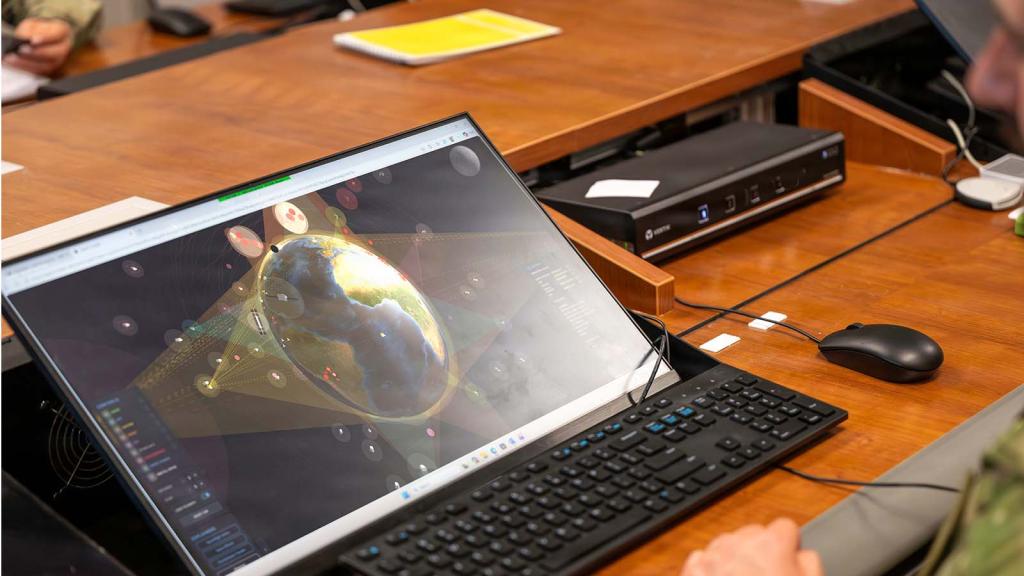
To understand how quickly a commercial mission can turn into a diplomatic crisis, Nunn School scholars Mariel Borowitz, Lincoln Hines, and Lawrence Rubin along with colleagues from the U.S. Space Force Schriever Space Scholars Program at the Johns Hopkins School of Advanced International Studies led a tabletop wargaming exercise involving American regional and space experts.
In their paper on the exercise, published in the journal Space Policy, the team envisioned a plausible 2029 crisis: A private Indian company, Chandra Ltd., lands near the moon's Shackleton Crater and declares a 50-kilometer “safety zone” around its operations. This maneuver, modeled on the language of the U.S.-led Artemis Accords, immediately triggers a standoff when American and Chinese companies — who already had plans for that same site — refuse to recognize the claim.
Writing about the exercise in War on the Rocks, Borowitz, Hines, and Rubin noted a dangerous gap: without widely accepted technical standards, a "safety zone" meant to protect equipment is easily misinterpreted as a military blockade.
“The perceived legitimacy of rules in space, as on Earth, is tied to the perceived fairness and transparency of the procedures used to create them,” the authors wrote. “With no agreed-upon process for resolving lunar conflicts, underlying mistrust can exacerbate tensions between great powers.”
Understanding these risks requires a deep dive into the internal logic of spacefaring nations. Hines, an assistant professor at the Nunn School, notes autocracies often pursue expensive space capabilities not for material payoff, but for "domestic mobilization and to legitimize their rule at home."
These domestic motivations are important to understand areas of mutual interests as well as risks, Hines said.
“For instance, China’s space ambitions, like those of the United States, are driven by several different motives,” he said. “U.S. policymakers need to understand those distinctions, or we will inadvertently foreclose any opportunities for risk reduction, and we may engage in a wasteful or perhaps dangerous arms race with China.”
Similarly, Rubin’s research into the space "renaissance" in the Middle East warns that the domain is becoming "hotter" as a theater for strategic signaling. When a nation launches a satellite, they are signaling technological maturity and military reach to their neighbors.
“What matters is how states signal, interpret, and respond to actions in space,” said Rubin, a professor in the Nunn School. “As the domain becomes more contested and yet interconnected, the real challenge is avoiding misperception and unintended escalation.”
And the window for building a rules-based order is closing, the researchers said in War on the Rocks.
“Our exercise serves as a cautionary tale,” they wrote. “The United States and other leading spacefaring nations should create mechanisms and procedures in real time to avoid conflict and escalation. If international governance procedures are not in place, we will be left to manage conflict with less credibility and fewer tools.”
This article is part of our feature on space policy in the Sam Nunn School of International Affairs in Georgia Tech's Ivan Allen College of Liberal Arts. To view the main story, click the button below.