Economists have long dismissed the public perception that presidents influence gas prices as economic illiteracy.
New research from Georgia Tech economists Dylan Brewer and Matthew Oliver calls that assumption into question, finding significant differences in average gas prices across administrations.
The study is timely, arriving amid widespread public discontent over rising fuel prices, with voter frustrations reflected in a series of national polls blaming the Trump administration.
Although the researchers do not determine how much of the price differences across administrations, if any, are caused by presidents themselves, they argue economists may have been too confident in dismissing the possibility without much direct evidence.
“If economists really think that the president doesn't have influence, the burden of proof is on economists to explain that these differences can't be interpreted as the result of each president's actions.”
— Dylan Brewer, associate professor in Georgia Tech's School of Economics
Why Haven’t Economists Studied This Question More Closely?
“Even though it's a topic of immense public interest, we found almost no literature on the question and it seems like it's been unduly ignored,” said Oliver, a professor in Georgia Tech’s School of Economics in the Ivan Allen College of Liberal Arts.
He points to the gap in perception between energy experts and non-experts as a potential culprit. In fact, this work was inspired by “I did that” stickers he saw on gas pumps in 2022, with an image of then-President Joe Biden pointing at the 20-year-high gas prices.
“I scoffed at the idea that the president can influence the retail price of gasoline, and I don't think I'm unique in that regard amongst my colleagues,” Oliver said. “So that leads me to believe that a big reason why this has never been researched thoroughly by economists is that we thought we already knew the answer to this question.”
But Brewer and Oliver’s work opens it back up to inquiry, and they encourage more research to determine which mechanisms are actually driving these changing prices.
“The more that you dig into it, based on the literature that exists in economics and studying things like the Strategic Petroleum Reserve, the more it's clear that there are actually more reasons to think that the president can influence fuel prices than not,” said Brewer, an associate professor in the School.
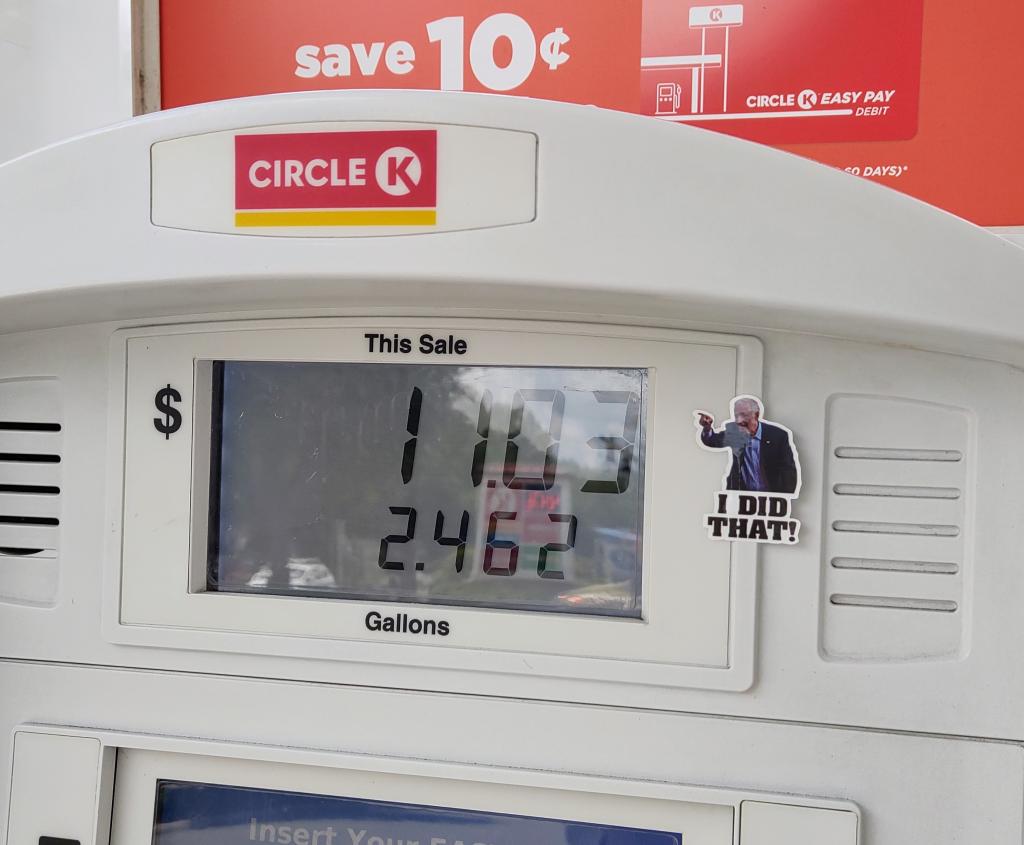
Oliver was inspired by the stickers he saw on gas pumps showing then-President Joe Biden pointing at the price saying "I did that." Photo by Whoisjohngalt, via Wikimedia Commons, licensed under CC BY-SA 4.0.
What Did the Researchers Find?
To explore the issue, Brewer and Oliver looked at both public opinion and real-world fuel-price data. For their paper, published in Energy Economics, they commissioned a nationally representative survey of 1,018 U.S. residents and 216 professional economists.
The results showed that 57.1 percent of energy experts surveyed believed the president had no or very little influence over retail gas prices, a viewpoint the authors also shared. In contrast, more than two-thirds of non-experts believed the president has a moderate or strong influence over gas prices.
So, the researchers analyzed 19 years of weekly fuel-price data in the U.S., Canada, Great Britain, and France to determine if the public was observing a real phenomenon. They found that:
- Average gas prices change under presidents: Average gas prices often differed significantly under different U.S. presidents between 2003 and 2022.
- The same pattern is seen abroad: Average gas prices also changed between many administrations in France, Great Britain, and Canada.
- These patterns remained even when controlling for factors such as crude oil prices, fuel taxes, economic downturns, and major international events like pandemics or war that can affect energy markets.
- However, the researchers did not claim to establish a causal link between the president and gas prices because too many additional variables are involved.
- The paper shows that Americans may believe this common media narrative because gas prices and presidential administrations are correlated.
The study doesn’t find price differences between every administration,
In one U.S. comparison, gasoline prices were about 39 cents per gallon higher in the early years of President Barack Obama’s administration than during the final years of President George W. Bush's presidency.
“In a very simple statistical sense, if you look at fuel prices during different presidential regimes under sets of controls, there are different fuel prices across presidents. And we can't say that that's because any president caused those changes, but the fact is that the prices are different across presidents,” Brewer said.
“So if economists really think that the president doesn't have influence, the burden of proof is on economists to explain that these differences can't be interpreted as the result of each president's actions.”
More featured research from the Ivan Allen College: Does the President Really Affect the US Economy?
Why Does It Matter Whether the President Affects Gas Prices?
Whether or not presidents actually affect gas prices, many people believe they do, and that’s enough to drive behavior in important ways, Oliver said.
As diesel prices hit record highs in the United States — with unleaded gas prices not far behind — polls show many Americans blame President Trump for the recent rise in gas prices, and perceive the Democratic Party as better equipped to address the issue. With midterm elections looming, these perceptions can have consequences at the polls.
“This question is highly important to almost everyone, so much so that it moves entire elections,” he said. “It drives economic activity; it's a litmus test for how the overall economy is doing at any given point in time. So, the motivation is to engage the public and try to arm people with better information about these debates when they go on in the public sphere.”
For instance, people in America link presidents and gas prices much more strongly when gas prices rise than when they fall. Brewer and Oliver found that for every dollar per gallon that gas prices go up, Google searches such as “Trump gas prices” or “Biden gas prices” jump about 53 percentage points. However, when gas prices fall by one dollar, searches don't change by a statistically significant amount.
“The discourse from the side of the experts needs to take this question more seriously, but I would say the same for the average political commentator's discourse as well, because they also assume and promote the idea that presidents can influence these prices,” Brewer said. “But it's just not that clear. Both sides are relatively confident, and the discourse should be a little bit more cautious.”
More featured research from the School of Economics: Does Wildfire Smoke Affect the Economy?
What’s Next?
Brewer and Oliver say more research is needed to establish or rule out a causal link between presidential policies and gas prices. Variables that clouded their analysis included long policy lag times, the fact that one leader inherits conditions created by previous leaders, the possibility that fuel prices themselves help determine who gets elected, and the many overlapping economic, political, and market forces that influence prices at the same time.
Rather than settling the debate, the researchers hope the paper encourages others to investigate the issue further, devising ways to better understand if there’s a relationship, and if so, how it works.
"I think what we are hoping is to start a new strand of literature, if you will, where economists and energy policy experts and analysts would be studying this question a little bit more deeply,” Oliver said.
"Presidents, Prices at the Pump, and the Difference in Perceptions Between Energy Market Experts and Non-experts," was published in Energy Economics in October 2026. Read more at: https://doi.org/10.1016/j.eneco.2026.109583.