
Widespread Electric vehicle adoption would lower energy prices 6% and strengthen national energy security, according to the new study from researchers in the Jimmy and Rosalynn Carter School of Public Policy.

Putting more electric cars on the road doesn’t just benefit those with enough money to buy the often-pricey vehicles, it also pushes down prices at the gas pump while strengthening U.S. energy security, according to new research from Georgia Tech’s Jimmy and Rosalynn Carter School of Public Policy.
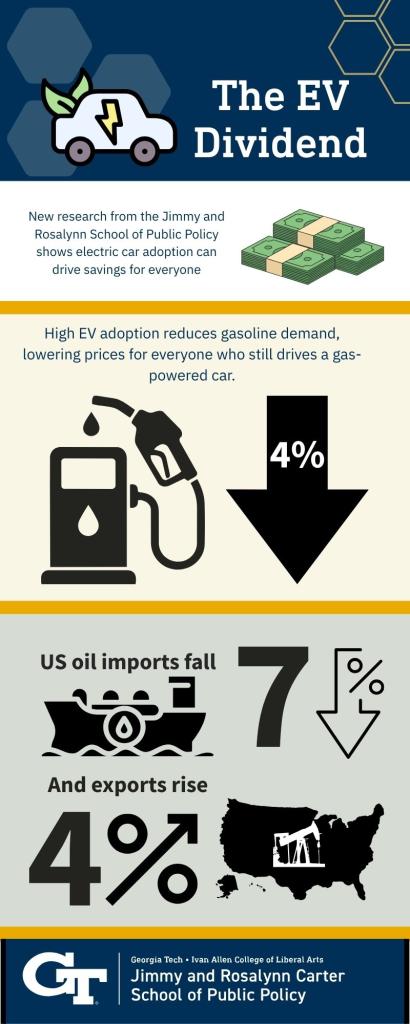
According to the study, published in Energy Policy, widespread adoption of electric vehicles, or EVs, by 2035 would cut energy bills for U.S. households by more than 6% — including more than 4% at the gas pump. It also would drive oil imports down by 7% and increase exports by nearly 4%, the researchers say.
However, those benefits are imperiled by the repeal of national electric vehicle incentives and the recent decision by the federal government to roll back EV-boosting rules meant to increase vehicle fuel efficiency and reduce pollution, according to the study’s authors, Ph.D. candidate Niraj K. Palsule; Marilyn A. Brown, Regents’ Professor and Brook Byers Professor of Sustainable Systems; and former graduate student Suprita Chakravarthy. Their study was conducted prior to the federal decisions.
“Proponents of eliminating fuel efficiency standards and other EV-boosting policies often frame those regulatory approaches as consumer-unfriendly, but our analysis shows that such policies have many long-term benefits, both for consumers and for the nation’s energy security,” Palsule said.
To reach their conclusions, the researchers used a version of the National Energy Modeling System created by Carter School researchers that more accurately captures the dynamic interplay of energy production, consumption, and demand compared to other models.
They modeled the impact of vehicle fuel efficiency standards and other policies between 2022 and 2035, first analyzing what would happen to the economy with no EV incentives and only less-stringent fuel efficiency standards dating back to before 2024. They then built a model that took a middle-of-the-road approach to EV growth between the now-repealed federal standards, which sought to more than double new EV sales to 69% by 2032, and standards adopted by California and 17 other states. Those rules, which remain in effect, seek to end the sale of new gasoline-powered vehicles in those jurisdictions by 2035.
The researchers found that, compared to the pre-2024 rules, the newer policies would cause household energy expenditures and gasoline consumption to fall across incomes, oil imports to fall, and oil exports to rise by 2035.
Those savings work across multiple pathways.
One is simple demand reduction: putting more electric vehicles on the road reduces the need for gasoline and imported oil, pushing pump prices down for all consumers. While upper-income households would save about 6.4% on energy, including gasoline, lower-income households likely to still be driving cars with traditional gasoline engines in 2035 stand to gain the most — spending 6.6% less on energy, according to the research.
The other pathway is through the “domino effect” that would occur thanks to cheaper, more efficient battery technology made to serve an increasing EV market. Widespread EV adoption would spur innovation and efficiencies that would make it less costly for utilities to store energy. Brown and Palsule describe this development as pivotal to helping stabilize costs and offset any potential increase in home electricity prices driven by EV adoption. Home electricity prices might even fall slightly, according to the study.
And because global oil demand seems unlikely to fall, U.S. oil producers would typically be able to ship some of the oil they would have used to make gasoline to other countries, increasing the U.S. role as a net energy exporter, according to the research. During shocks, such as the ongoing conflicts in Ukraine or Iran, Brown and Palsule say electric vehicle adoption would help cushion the U.S. economy.
Given recent events, Palsule and Brown say it’s unclear whether any of the predicted savings will come to pass, however. Not only have the federal rules been repealed, the U.S. government and some other state governments are also challenging the emissions rules adopted by California and 17 other states, administratively and in court.
Even if those rules remain in place, such a piecemeal approach may not be enough to keep the momentum going, or to realize all the benefits of a widespread EV transition, they said.
“Maximizing the benefits of a transition to electric vehicles that would both help consumers and strengthen the nation’s energy security can only come with a nationwide strategy,” Brown said.
The study, “Unleashing Storage by Driving Electric: A Pathway to Affordable, Secure and Clean Energy,” was published Feb. 9, 2026, in Energy Policy. It is available at https://doi.org/10.1016/j.enpol.2026.115138.
Palsule developed the concept and methodology and wrote the initial draft. Chakravarthy assisted with visualization, analysis, and data curation. Brown supervised the research and contributed to writing and editing.
The research was supported by funding from the Ray C. Anderson Foundation, Georgia Tech’s Energy Policy and Innovation Center and the Brook Byers Institute for Sustainable Systems at Georgia Tech.
Interested in climate and energy reserach?

Explore the work of the Climate and Energy Policy Lab, directed by Marilyn A. Brown, which examines policy issues related to energy transition, smart grids, and more.