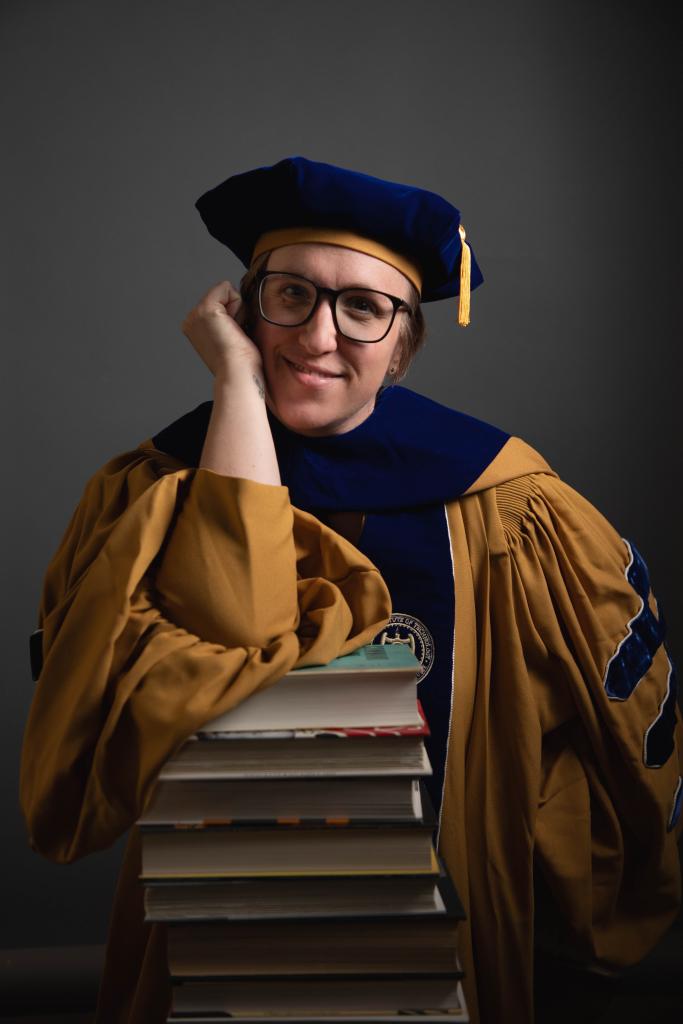
When Zoe Gastelum’s work in nuclear nonproliferation began raising questions about artificial intelligence policy, she came to Georgia Tech’s Ivan Allen College of Liberal Arts to find answers.
This Spring, Gastelum will graduate with a Ph.D. in Public Policy, her education sponsored by her employer, Sandia National Laboratories. In the summer, she will present her recommendations for AI policy for international nuclear safeguards to the International Atomic Energy Agency in Vienna.
“These agencies operate on tight budgets, so incorporating AI is a really exciting prospect for them,” Gastelum said. “At the same time, their work is highly scrutinized because the conclusions that they make about the status of a country's nuclear program significantly influence regional and global security. So they have to incorporate AI responsibly and transparently.”
Working Toward Peace
Gastelum’s career in nuclear nonproliferation began with a college internship 20 years ago, where she said she was immediately drawn to the impact of the work.
“Even if it wasn't directly my hand signing a treaty, I felt like the work that we were doing really supported this foundation of world peace,” she said.
Her move into policy followed naturally. Gastelum began by building models to help analysts detect when countries are illegally developing nuclear weapons programs. That expanded to studying how humans interact with those models and tools, and eventually to questions about their broader implications.
“What does it mean for society? What should we be doing? Is this the right model to be building for global peace and security?” she said. “That made me really want to get more into the policy side of it to think about what the impact on society is of some of these tools and capabilities that we're developing.”
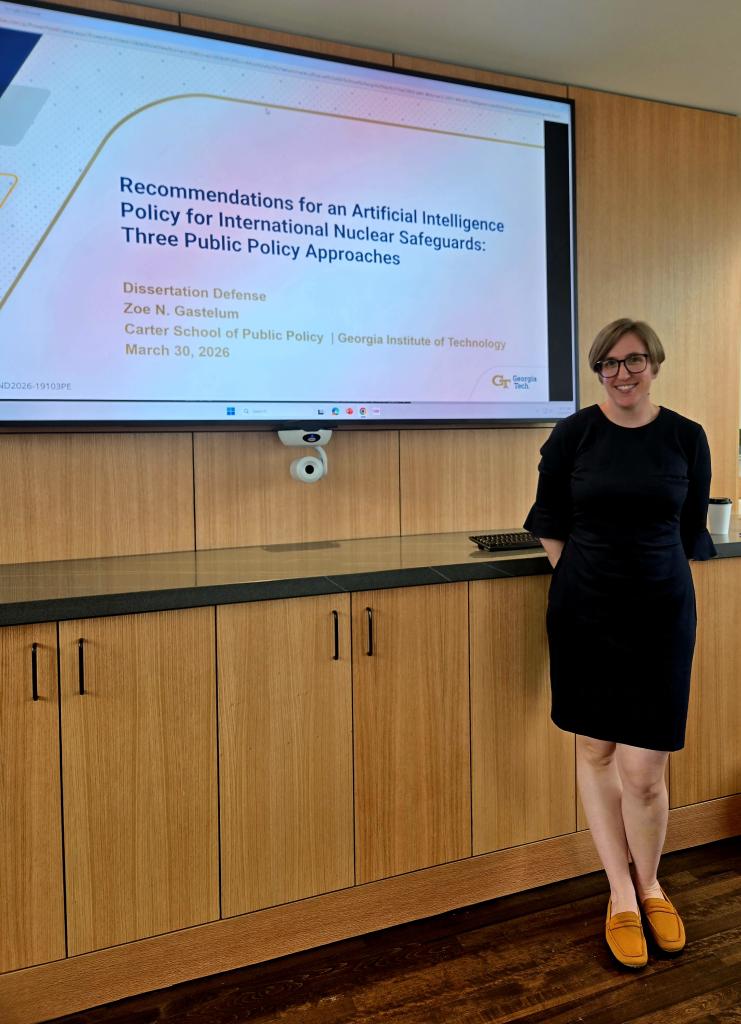
Gastelum presenting her Ph.D. dissertation defense on "Recommendations for an Artificial Intelligence Policy for International Nuclear Safeguards: Three Public Policy Approaches."
Only at Georgia Tech
Once she had the questions, Gastelum knew where to go to find the answers. The doctoral program at the Jimmy and Rosalynn Carter School of Public Policy in the Ivan Allen College of Liberal Arts is the only one she applied to, because of its emphasis on technical skills and interdisciplinary work.
“I really wanted this unique combination that Georgia Tech has, which is policy studies in a liberal arts school in the middle of a STEM-focused university where you could get access to people who were looking at problems from all these different angles,” she said.
Gastelum appreciated that statistics, economics, coding, and research design courses were built into the program rather than being optional, allowing her to independently research and better understand the tools she works with.
“But also, being situated at Georgia Tech, where there are so many engineers and liberal arts students mixing together in courses, was this really unique opportunity to gain these perspectives from folks from all different domains and walks of life,” she said. “I think that's the most exciting way to work. To me, the Ivan Allen College really embodied that value of multidisciplinary work.”
Leading Research at Sandia National Laboratories
Gastelum is returning to full-time work at Sandia National Laboratories to lead the Proliferation Detection Data Exploitation research and development department, a role she says she was more competitive for because of her Ph.D. She will lead a team of computer and data scientists working to detect nuclear proliferation through advanced data analytics.
“I started this whole new track, which I wasn't anticipating, but I really love being able to facilitate research at this broader level now,” she said. “Not just my own, one project at a time, but being able to support whole programs of research. Being able to shape those programs and provide leadership roles has been really fun and something that I don't think that I could have done without this degree.”
With her Ph.D. in Public Policy from the Carter School, Gastelum can amplify her impact in the field she’s been passionate about for her entire career — supporting global stability.
“Working in nuclear nonproliferation, you can see all of these conflicts going on around the world that are maybe not as bad as they could have been because of the work we do in trying to limit the spread of nuclear weapons,” she said. “And it feels really good to be part of that mission space.”