
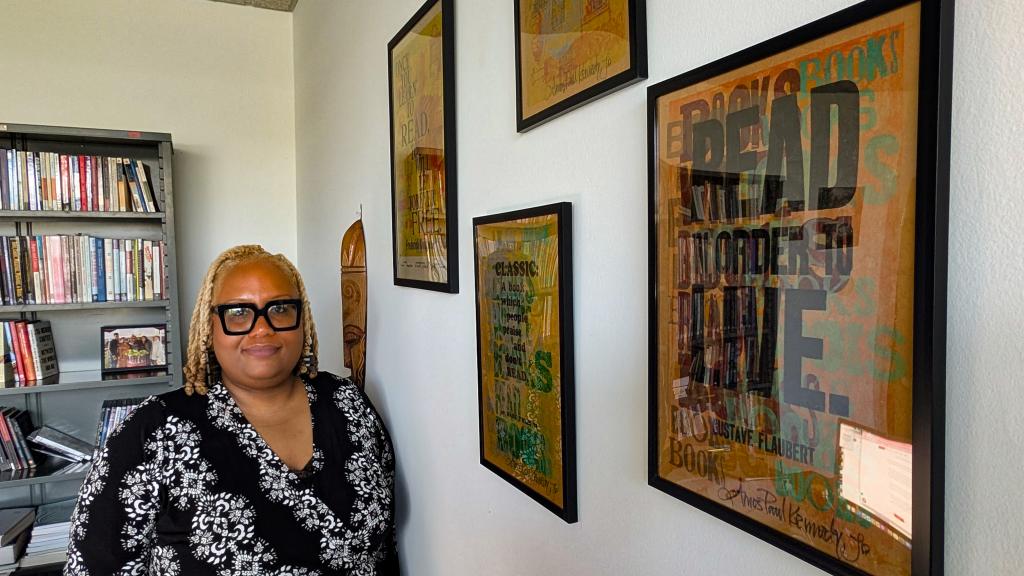
When Susana Morris signs autographs of her new book, Positive Obsession, she includes a phrase coined by the book’s subject, science fiction legend Octavia Butler: “So be it. See to it.”
It’s a nod to the many ways in which Butler overcame the obstacles of poverty and race to become a beloved figure in the world of science fiction literature. It also serves as a reminder of Morris’ advice for her students in Georgia Tech’s School of Literature, Media, and Communication and across Georgia Tech.
“You want to major in Literature, Media, and Communication and go to work in animation after graduation?” as if speaking to a student. “Okay, so be it. Now, see to it,” Morris said during a recent interview.
Morris’ critically acclaimed book takes a deep dive into Butler’s approach to writing and creativity, revealing lessons that are as applicable to Georgia Tech students seeking to make their mark today as they were to Butler in the 1980s. Back then, Butler was not the literary icon she would become, but rather a struggling writer trying to make ends meet and thinking about pawning the Remington typewriter her mother had given her.
“Being a New York Times best seller is not up to the writer; otherwise, everybody would be one. But she positioned herself in a way to get what she wanted. And she always emphasized habit and persistence over talent,” Morris said.
Morris, an associate professor who specializes in science fiction and Afrofuturism, began researching the book out of a desire to give her students more insight into Butler, her work, and her habits.
“I wanted to know more about her creative process,” Morris said. “There were a lot of interviews, but Butler was a pretty private person, so I always came up against a bit of a wall. So I wrote this book.”
A Positive Influence
Morris has embedded Butler’s work and career throughout her work as a scholar. Not only has she written Positive Obsession, she has published research on Butler and teaches the author’s books to Georgia Tech English students. She also is director of Earthseed, an Afrofuturist digital humanities research project funded by the Andrew W. Mellon Foundation. Among other things, the project examines how traditional Black cultural practices can contribute to climate resilience. It is named after a secular religion that features in Butler’s post-apocalyptic novel, Parable of the Sower. For more information on Earthseed, visit the project’s website.
Butler: Student, Not Prophet
She began in 2020, just before the Covid-19 shutdown, and completed her work during a pair of fellowships in 2022, one at the Effron Center for the Study of America at Princeton University, the other at the University of Michigan’s Center for the Humanities.
She spent long hours at The Huntington, a cultural and educational center in San Marino, California, which houses Butler’s papers. There, she encountered a voluminous record of Butler’s personal life, such as receipts for bills and personal musings, as well as details of her meticulous research into topics such as linguistics, sociobiology, the flora and fauna of the Amazon – a location she visited with a UCLA research group.
“She was self-taught, an autodidact,” Morris says of Butler, who never officially earned more than an associate’s degree but seems to have gained the equivalent of multiple advanced degrees in a variety of fields in her quest to help make the worlds she created feel authentic.
Her books are known for their verisimilitude and prescience. For instance, her 1993 novel, Parable of the Sower, saw renewed popularity over the last decade for its depiction of a United States suffering through the effects of climate change, wealth inequality, social decay, and a populist president rising to power on the slogan, “Let’s Make America Great Again.”
“People frequently call her a prophet, since many of the things she wrote about have come to pass,” Morris said. “But she went and discovered these things. She was an expert at patterns, at recognizing recurring patterns in human behavior. And she was a student of history.”
Lessons for Today's Students
Butler would likely counsel today’s students to seek out the same kinds of wisdom, and to also apply that wisdom to improving our shared tomorrows, Morris said.
“I think she would encourage them to be sharp thinkers and to work to understand the patterns around us that will shape the future,” Morris said. “Predictions don’t always come true, but they are one way to give warning when we see ourselves drifting in dangerous directions.”
That’s one reason, Morris says, that teaching literature, especially science fiction, is so important at a technological university such as Georgia Tech.
“In every discipline, there is something about having a forward-looking, futurist perspective, one that is maybe a little weird, a little strange, a little off the beaten path,” Morris said. “Science fiction is particularly good at that, and it has lessons for us no matter what line of work we’re in.”
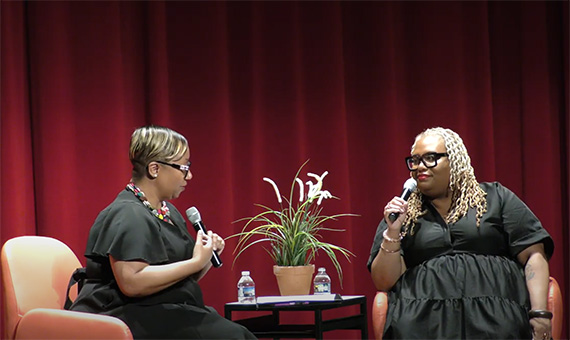
Click on the image to watch Susana Morris discuss Positive Obsession at an event sponsored by Charis Circle at the Auburn Avenue Research Library.

Octavia Butler is an influential figure in Afrofuturism, an approach present in literature, art, fashion design, even architecture, that incorporates Black cultural and historical elements into a futurist viewpoint. Click on the image to learn more about it from Georgia Tech experts, including Morris.