
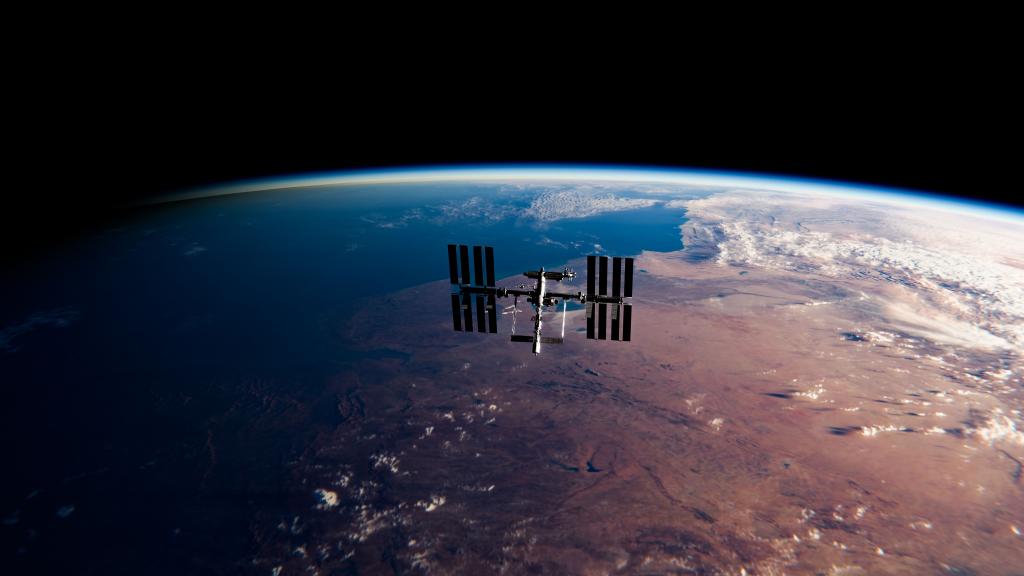
The new lab will draw on Georgia Tech's strengths in engineering and international affairs to help inform space policy.
As space becomes more crowded, and more congested, engineers and policymakers are increasingly working together to realize a shared vision of a peaceful, prosperous final frontier. In response, Georgia Tech's Sam Nunn School of International Affairs and Daniel Guggenheim School of Aerospace Engineering are partnering to create the Engineering Space Policy Laboratory (ESPL), an interdisciplinary collaboration drawing from Georgia Tech's strengths in the engineering and social sciences.
Tackling the fast-growing problem takes coordination across the globe for the right solutions. Led by Assistant Professor Thomas González Roberts, ESPL will focus on international coordination, sustainability, and security in outer space. Roberts is a member of both the Nunn School and Guggenheim School faculties. With a foot in both worlds, Roberts is building an interdisciplinary research environment that few other universities can support.
“EPSL is a policy-impact laboratory, dedicated to creating domain-informed, data-driven tools for outer space decision-makers,” Roberts said. “I’m thrilled to be taking on this work with our world-class students here at Tech.”
“The world's most pressing issues, from terrestrial conflict to managing our increasingly crowded orbital space, don't respect academic boundaries. This lab embodies the Nunn School's commitment to breaking down those silos."
— Adam N. Stulberg, Chair of the Sam Nunn School of International Affairs
As a trained astrodynamicist, Roberts uses data derived from the Space Surveillance Network — a U.S. Space Force-operated system of telescopes and radar systems — to track space objects and characterize their behaviors on orbit. He then compares those actual behaviors to the mission plans that satellite operators and governments share with international organizations to study patterns of rule-following and rule-breaking in the space domain.
“Taking photos of the sky and calculating satellite paths is a complex aerospace engineering task — it's astrodynamics. But understanding why we do it, and how that data is used, brings us into the realm of international affairs and social science,” Roberts said.
“It’s risky work, especially when major spacefaring nations treat space as a potential battlefield, and satellite operators rarely communicate directly with each other. While there's never been a war in space, there are military space agencies that spend billions of dollars every year training and equipping forces to fight a war in that domain one day.”
In ESPL, early career scholars will develop research products that reach beyond the academic sphere. Projects will extend beyond conference papers and journal articles to tools that can be directly used by policymakers, such as interactive models, briefings for decision-makers, and domain specific editorials.
Study With Roberts
Students who are interested in ESPL’s research areas may also want to take Roberts' courses:
- INTA — 4803/8803 Space Sustainability
- AE 4532 — Spacecraft Flight Dynamics.
Both will be offered in Spring 2026.
“The world's most pressing issues, from terrestrial conflict to managing our increasingly crowded orbital space, don't respect academic boundaries. This lab embodies the Nunn School's commitment to breaking down those silos,” said Adam Stulberg, Nunn School chair.
"You can't create effective policy on complex technological issues without first understanding the underlying science, which is why our curriculum centers technological understanding and our faculty includes professors with training in chemistry, physics, engineering, and more. At the same time, technological innovation at the new frontier must be informed by social and behavior issues to have a lasting impact on humanity.
"We're excited about this collaboration, which will help us further our mission to ensure our students are not just commenting on our future, but actively helping to shape it.”
Roberts’ vision is to have students from many disciplines working side by side on problems that demand technical expertise and global awareness. A key part of his role is demonstrating how this interdisciplinary approach strengthens engineering education.
By integrating intercultural and interdisciplinary communication into the curriculum, students gain essential skills for leadership and career advancement — skills often missing from traditional engineering programs.
“We build partnerships with stakeholders in U.S. and international space governance. We've already started on that through my role as the International Telecommunication Union’s (ITU) Academic in Residence and the work of my colleagues from the Nunn School’s Center for Space Policy and International Relations, but this model was designed from the start to directly support student researchers, too,” Roberts explained.
Explore Space Policy in the Ivan Allen College

Space debris poses a threat to life and work in Earth's orbit. Find out what Nunn School experts are doing to help resolve the problem.

Learn from an Ivan Allen College graduate how liberal arts at Georgia Tech can give you the tools you need to get a job in space policy.

The Center for Space Policy and International Relations, located in the Nunn School, seeks to advance research across a range of space-related fields.