Artificial intelligence doesn’t just consume energy via data centers and hardware. It also increases productivity, which comes with its own energy and emissions costs.
A new study from Georgia Tech’s Jimmy and Rosalynn Carter School of Public Policy is one of the first to estimate how changes in productivity due to AI will affect energy consumption.
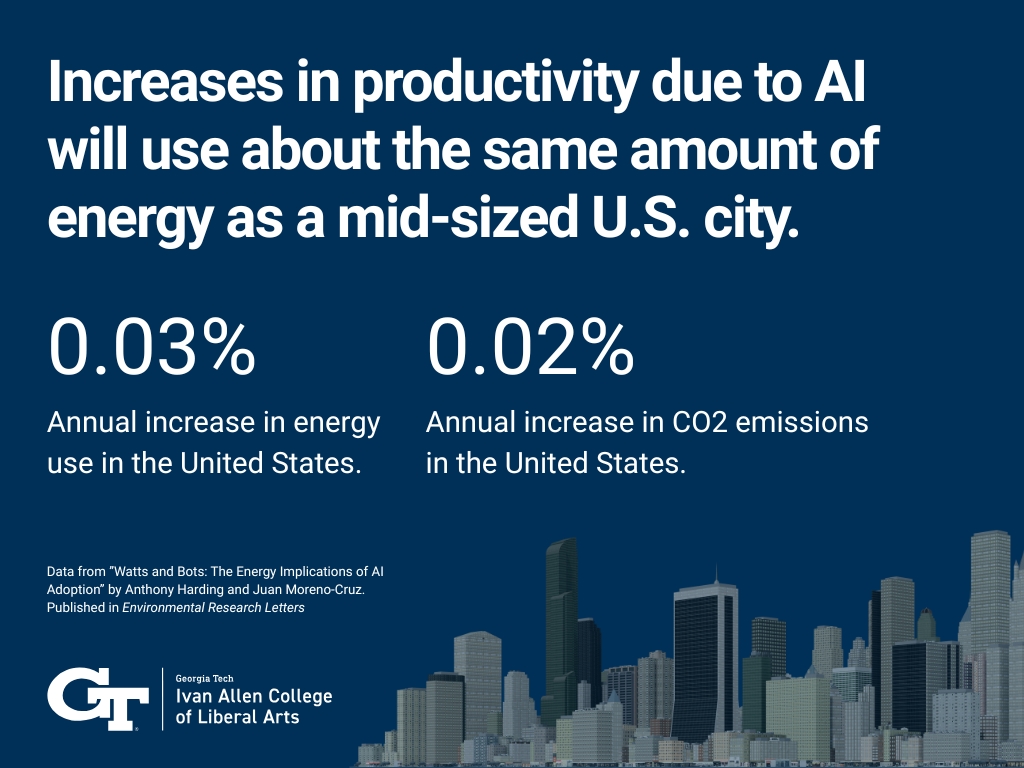
The paper, written by Anthony Harding and co-author Juan Moreno-Cruz at the University of Waterloo, suggests that greater productivity due to AI will result in a 0.03% annual increase in energy use in the United States and a 0.02% increase in CO2 emissions. That’s about equal to the yearly electricity use of a mid-sized U.S. city.
“If AI is as transformational as some expect it to be, it makes it even more important to think about the knock-on effects throughout the economy, beyond just the demands of the technology itself,” Harding said. “U.S. energy demand has stabilized since the mid-2000s. There is potential for AI to disrupt this, but there is also large uncertainty.”
That’s where Harding and Moreno-Cruz’s forecasting comes in.
Providing policymakers with a clearer picture of what’s to come can bring plenty of benefits, such as ensuring energy infrastructure is prepared for the future load and guiding new regulations that balance economic gain with sustainability.
The changes in energy use differ across sectors, with the researchers expecting the largest increases in education, publishing, and the financial sector. In contrast, sectors such as fishing and aquaculture, as well as public administration and defense, are largely unaffected by AI and show no change.
The authors caution that their estimates are based on the expected effects of AI on current practices and do not account for the possibility that it may create new roles or tasks. They also assume sectors will stay around the same size they are now and not grow or shrink drastically. In addition, the researchers do not consider the possibility that AI may develop new energy-saving techniques to offset these increases.
“Watts and Bots: The Energy Implications of AI Adoption” was published in Environmental Research Letters. Read more at: https://doi.org/10.1088/1748-9326/ae0e3b